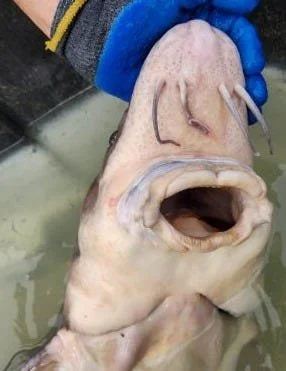
The warm, spring air sizzled with electricity in central Kansas. Thunderstorms echoed in the distance as intimidating clouds rolled across the prairie. Suddenly, rain poured down, swelling the small creeks that fed the Kansas River. At Kaw Point in Kansas City, those drops joined trillions of others from across the Missouri River basin. Ordinary storms like that have occurred on North America’s grand interior grasslands for millennia, fueling rivers we know as the Kansas, Platte, Red, Missouri, and many more.
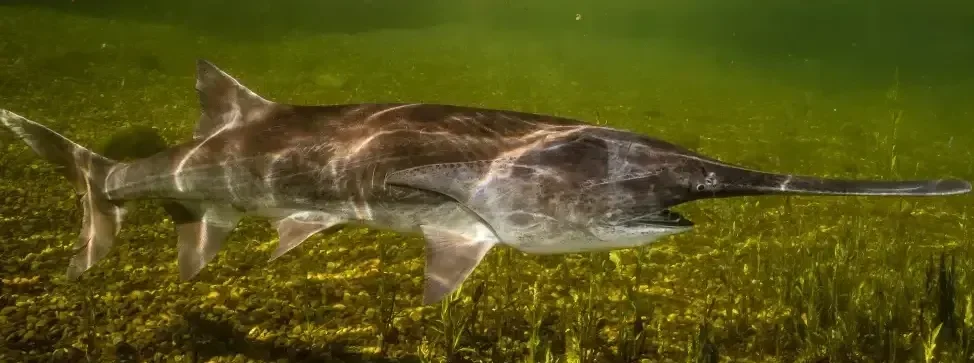
Water supported the sea of grasses stretching as far as the eye could see. During the Pleistocene, there were lions, hyenas, mammoths and giant beavers. North America even had its own camel species. Great Plains mammals are famous in North America. Bison, elk, wolves, grizzly bears, mountain lions, pronghorn, mule deer, white-tail deer, black-footed ferrets, and many more loom large in the national animal consensuses. Everyone knows bison. They are the national mammal of the United States after all.[1] But what about the fish? Pallid and shovelnose sturgeon, paddlefish, the blue sucker, and many more are all just as interesting as the plains mammals, but they are harder to observe. I’ve already written about paddlefish so let’s talk about sturgeons! Lake, pallid, and shovelnose sturgeons already called the Missouri home when the modern river was born.
Sturgeon look otherworldly for good reason. It’s almost like they don’t belong in the same river as modern fishes. They are large, armor coated animals that evolved in a different era. Their bodies are covered in large diamond shaped boney ganoid scales called scutes. They are similar to scales of other ancient fish in the gar family. For the modern world, they are overkill. But, the earliest known (at least to me) sturgeon fossil in what would become the Missouri River drainage dates back to roughly 78 million years ago (their family Acipenseridae dates back to about 200ish million years).[2] At the time, much of the Missouri River basin was a great inland marine sea. Those scales were armor against massive marine predators like the reptile Tylosaurus Proriger. From fossil evidence, it grew over 45 feet long. Its mouth was full of razor sharp teeth. If you’re ever in Wichita, KS you can visit Logan the Tylosaur at the Museum of World Treasures. About 70 million years ago, the sea began retreating and the land dried out. The threats slowly vanished but sturgeon and paddlefish were the lone survivors from a bygone era.
Before ice enveloped North America, the ancestral Missouri flowed north into Hudson Bay. About two and a half million years ago Earth decided it needed to cool off for a bit and the Ice Age kicked into gear. Ice blocked the historic Missouri and over the course of a couple of million years the river moved into its current valley. The river started off as a series of smaller streams until they coalesced into what we call the Missouri about 100 thousand years ago. At that point, sturgeon were the oldest fish on the block. They ruled over flathead catfish who’d been around for about 20 million years and various bass species which showed up about eight to two million years ago. The historic Missouri looked much different than the river we know today.
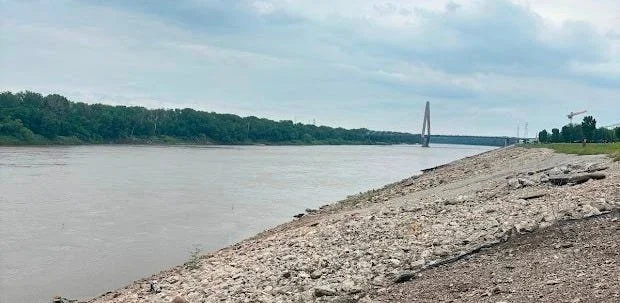
The modern Missouri River in downtown KCMO. Taken by me
The Missouri begins its journey at Three Forks, Montana where the Jefferson, Madison, and Gallatin rivers meet. From there, it breaks free from the Missouri Breaks and spills out onto the Great Plains. It then flows 2,500 miles to St. Louis, Missouri where it joins the Mississippi. Before dams, dikes, and levees it was a wide, meandering river. In the spring, it swelled with snow pact runoff and rain. Over generations, the main channel shifted as the river consumed and created its own banks. All three sturgeon species are benthic fish who hang out in the lower third of the water column. They’ll eat all kinds of small creatures including the stray cicada nymph.[3] They need slower moving water and the Missouri was prime sturgeon habitat. Wayne Nelson-Stastny with the U.S. Fish and Wildlife service said it best “if you were going to design a fish in an engineering program to adapt to the Missouri River, where you can’t see but you can smell, you can hear, and you have to be able to handle the currents, a pallid sturgeon is what you would design.”[4] Shovelnose, pallid, and lake sturgeon all faced the tidal wave of over consummation in the 19th and 20th centuries.
Land based protein in almost any big box grocery store in America nowadays is limited to pork, chicken, and beef with a side of lamb and turkey thrown in. In previous centuries, local markets included everything from pork, beef, chicken, and deer to buffalo (the fish), carp, paddlefish, and even sturgeon. People ate a lot of sturgeon back in the day. The Mississippi and Missouri Rivers supplied most of the nation’s supply. In 1912, The Quad-City Times reported that in just one day of fishing commercial fisherman on the Mississippi caught several thousand pounds of sturgeon. The roe was salted and shipped east and the fish was salted and smoked. The paper reported that “the small hackleback sturgeon [shovelnose], formerly considered worthless by fisherman, now is in especial demand, retailing at 15 and 18 cents a pound.”[5] As I’m writing this article in May, 2026 that’d be about 5 to 6 dollars a pound. No wonder sturgeon were popular. That’s cheap! I wish we didn’t overfish and pollute the Missouri so I could take advantage of that cheap, local, and organic meat. Unfortunately the next couple of decades ensured that isn’t possible.
Black Friday set the stage for sturgeon and the Missouri in the 20th-century. Sturgeon were declining already, but after 1929 they faced an even hungrier, more desperate population. In 1939, Missouri adapted new fishing regulations that legalized gigging sturgeons and paddlefish.[6] Gigs are multi-pronged spears people normally use for frogs. I wouldn’t call any gig that could pierce sturgeon scales a gig. That’s a spear like they use up north to get sturgeon through the ice. Between commercial harvest and individual fisherman, sturgeon never stood a chance. The country also needed work and the Missouri provided jobs.
In 1937, Fort Peck dam changed everything for the Missouri river and its sturgeon. After decades of lobbying; farmers, small town residents, urbanities, and titans of industry in the American heartland finally convinced the federal government to dam the Missouri. People needed jobs and the cities along the Missouri’s banks needed flood protection. President Roosevelt came to the rescue when he authorized the project in 1933. Construction started the same year. It was a perfect pairing of opportunity and need. It took a couple of more decades and five other dams but America’s longest river was restrained.
Between the dams and overfishing sturgeon populations tumbled. Writing for the Washington Citizen Izaak Walton Scribe reported in 1948 that on the Missouri “Some forty years ago, it was no trick at all to catch more sturgeons than you knew what to do with on two or three small throw-lines. One line with six or seven hooks, raised four to five times a day, produced all the sturgeons the family could eat in several days.” Scribe noted that many fisherman correctly blamed the changes to the Missouri for the decline.[7] Apparently no one thought fisherman catching upwards of 21 sturgeon per day played any role in the drop. Either way, over the next few decades their population went into free fall. By 1959, pallid sturgeon were nearly gone from the Missouri in Iowa. Roy and Harold Pratt caught two pallids from the river. Delmar Robinson, a fisheries biologist with the state of Iowa, had to identify the fish for the Pratts. At the time, the Iowa Conservation Commission stated that the fish was “quiet rare” and illegal to catch. They kindly asked any anglers to return them safely to the water.[8] Today, only the shovelnose is abundant enough to be legally harvested in the Missouri River watershed. The only states where it is illegal to keep them are North and South Dakota. In Iowa, it’s even still legal to commercially harvest shovelnose![9]
Pallid and lake sturgeons are in worse shape but there are signs of hope. Pallid sturgeon were listed as endangered under the Endangered Species Act in 1990 are still listed despite ongoing restoration efforts. They’ll probably never fully recovery but in 2025 biologist in Montana observed pallid sturgeon spawning in the upper Missouri River. According to Pat Braaten, a fisheries biologist with the Columbia Environmental Research Center’s Fort Peck Field Research Station, the pallids introduced in the 1990s and early 2000s are starting to reach sexual maturity.[10] With all the changes on the river, I don’t imagine they’ll ever fully recovery but there is still hope! Lake sturgeon recovery is ongoing as well. The Missouri Department of Conservation started its lake sturgeon recovery program in 1984. It’s a slow road to recovery, but just this year (2026) biologist in Kansas and Nebraska sampled lake sturgeons. The Kansas fish was caught in the Kansas River just west of the confluence of the Missouri and Kansas rivers at Kaw Point in Kansas City, Kansas. I can’t find any official measurements but it looks small (for lake sturgeons!) in the photograph.[11] In 2022, an angler on the Kaw caught a lake sturgeon and Kansas Department of Wildlife and Parks said it was only the 16th lake sturgeon they recorded in the past 25 years.[12] So, this new fish joined an exclusive club. The Nebraska laker was sampled just downstream of Gavin’s Point Dam on the main channel of the Missouri.
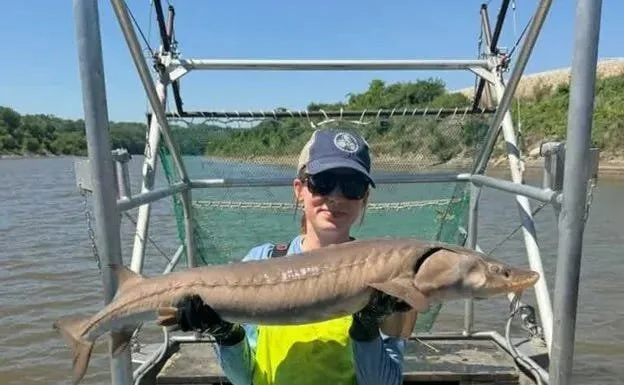
A rare lake sturegon caught in sampling by biologists with the Kansas Wildlife and Parks Service. Photo from the KWPS
The Nebraska sturgeon was caught on April 14, 2026 by a team of fisheries biologist. It measured 59.6 inches and weighed 70 pounds. It’s big by freshwater standards but lake sturgeon can get upwards of 200 pounds so even this fellow is small for its species. We know more about this fish thanks to a PIT (passive integrated transponder) tag that biologists in Missouri fitted to it back in 2017 in central Missouri. In 2017, it weighed 29 pounds and measured 47 inches long. It swam 681 miles upstream (at least once)! Like pallids, lake sturgeon take a very long time to reach sexual maturity so this fish could be one of the first classes of baby fish released into the Missouri back in the early 2000s.[13] It will likely be a few decades before we know for sure, but hopefully these fish are a positive sign on the road to sturgeon recovery. There is a long way to go and it will take a lot more time, money, and effort but these fish are worth it. If we’re able to bring their populations back to within reach of their historic levels it will be yet another cap in the feather of the North American conservation model.
[1] If you want to read more about those animals, I’d recommend anything by Dan Flores. Coyote America and American Serengeti are personal favorites.
[2] Grande, Lance, and Eric J. Hilton. “An Exquisitely Preserved Skeleton Representing a Primitive Sturgeon from the Upper Cretaceous Judith River Formation of Montana (Acipenseriformes: Acipenseridae: N. Gen. and Sp.).” Memoir (The Paleontological Society) 65 (2006): 1–39. http://www.jstor.org/stable/4095815.
[3] Harrison, Audrey B., Steven G. George, and William T. Slack. “Nymphal Cicadas (Hemiptera: Cicadidae) as a Prey Item of Shovelnose Sturgeon (Scaphirhynchus Platorynchus) in the Lower Mississippi River.” Southeastern Naturalist 10, no. 2 (2011): 371–73. http://www.jstor.org/stable/41263018.
[4] Ancient Fish, Modern Problem: How the Pallid Sturgeon could be a Warning for the Missouri River, Elizabeth Rembert, KCUR 6/12/2023, https://www.kcur.org/2023-06-06/pallid-sturgeon-problems-on-the-missouri-river accessed 6/1/2026.
[5] Caught in Nets, Quad-City Times, 03/12/1912.
[6] New regulations for Fish and Game, Butler Daily Democrat, 10/06/1939.
[7] Fishing Season Starts, Izaak Walton Scribe, Washington Citizen, 2/27/1948.
[8] Outdoors With Ole, The Tribune, 07/15/195
[9] State regulations in MT, ND, SD, IA, NE, MO, and KS. I said the Missouri watershed because I’m not sure what the exact regulations are for the Missouri itself in each state. Fishing regulations can be complicated. Make sure you know the rules on your body of water.
[10] Endangered Palid Sturgeon Successfully Spawn in the Missouri River, Brett French, Billings Gazette 09/12/2025, https://billingsgazette.com/outdoors/article_eb4e60d2-85fd-4a1d-b704-21170c73071b.html accessed 6/7/2026.
[11] Kansas River Yields Rare Lake Sturgeon. Wil Day, KSN, 05/19/2026. https://www.ksn.com/news/state-regional/kdwp-sturgeon-conservation-efforts/. Accessed 5/20/2026.
[12] Rare Fish Caught out of Kansas river, KDWP Confirms. Matthew Self, Fox 4 KC, 12/06/2022. https://fox4kc.com/news/rare-fish-caught-out-of-kansas-river-kdwp-confirms/ accessed 5/23/2026
[13] Rare Lake Sturgeon made 681-mile Swim. Rural Radio Media Release, 6/5/2026. https://ruralradio.com/krvn/news/rare-lake-sturgeon-made-681-mile-swim/ accessed 6/6/2026.
Sed purus sem, scelerisque ac rhoncus eget, porttitor nec odio. Lorem ipsum dolor sit amet.